
Dormant Company - Professional Procedure Manual
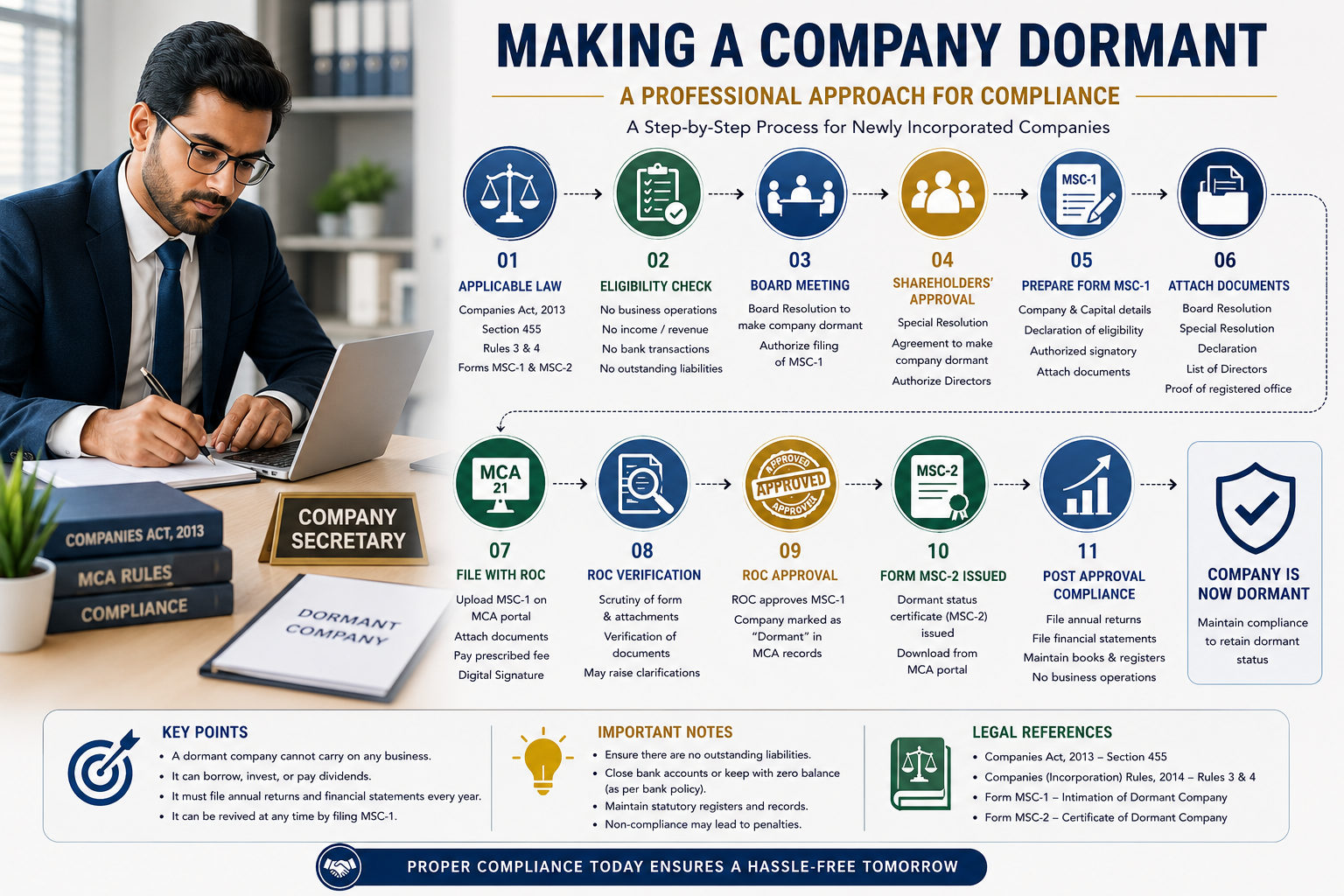
Dormant Company - Professional Procedure Manual
Applicable Law
Dormant company status is governed by Section 455 of the Companies Act, 2013, read with the Companies (Miscellaneous) Rules, 2014. It gives a company that has stopped active business — but does not wish to be struck off permanently — a legally recognized, low-compliance "paused" status. Two categories of company qualify:
- Future-project / asset-holding company — formed and registered to hold an asset, intellectual property, or to execute a future project, and not yet commercially active.
- Inactive company — has not carried out any significant accounting transaction in the two financial years immediately preceding the application, and has not filed annual returns/financial statements for those two years (or has filed them, but reports nil activity).
A significant accounting transaction excludes: payment of fees to the Registrar, payments made to fulfil requirements of the Act or other law, allotment of shares to fulfil the requirements of the Act, and payments for maintenance of the company's office and records.
Relevant Legal Provisions
- Section 455(1) — Conditions under which a company may apply for dormant status.
- Section 455(2) — Registrar's power to issue a certificate and maintain a register of dormant companies.
- Section 455(3) — Minimum number of directors a dormant company must maintain.
- Section 455(4) — Registrar's suo motu power to strike off a dormant company that fails to file returns for two consecutive years.
- Section 455(5) — Compliance requirements applicable to a dormant company.
- Rule 3, Companies (Miscellaneous) Rules, 2014 — Application procedure (Form MSC-1).
- Rule 4 — Issue of certificate of dormant status (Form MSC-2).
- Rule 5 — Register of Dormant Companies maintained by the ROC.
- Rule 6 — Minimum director requirement, annual filing (Form MSC-3), and physical office requirement during dormancy.
- Rule 7 — Application for obtaining status of an active company (Form MSC-4, with Form MSC-3 for the relevant period).
- Rule 8 — Registrar's power to strike off the name of a dormant company that has not filed MSC-3 for two consecutive years.
Current Fee Relief — CCFS-2026
The Ministry of Corporate Affairs has introduced the Companies Compliance Facilitation Scheme, 2026 (CCFS-2026) under General Circular No. 01/2026 dated 24 February 2026, issued under Section 460 read with Section 403 of the Act. It was originally open from 15 April to 15 July 2026, and has since been extended to 31 August 2026 (General Circular No. 03/2026 dated 8 July 2026, citing MCA21 data-centre capacity restoration following a fire incident).
Relevant to this procedure, the scheme allows:
- Filing Form MSC-1 for dormant status at 50% of the normal government fee (normal fee is ₹5,000, so effectively ₹2,500 during the scheme window).
- Clearing any pending MGT-7/MGT-7A or AOC-4 filings first, at only 10% of the accumulated additional (late) fee instead of the standard ₹100/day uncapped penalty — useful since pending annual filings must be cleared before MSC-1 can be filed.
Preliminary Verification
Before drafting any resolution, pull the company's MCA master data and verify:
- Company status on the MCA V3 portal shows Active (not Active–Non-compliant or Under liquidation).
- All statutory returns — MGT-7/MGT-7A (annual return), AOC-4 (financial statements), and DIR-3 KYC for every director — are up to date. If any are overdue, complete them first (see CCFS-2026 relief above) since a company with pending filings cannot file MSC-1.
- No inspection, inquiry, or investigation has been ordered, is being carried out, or is pending against the company under the Act.
- No prosecution is pending in any court in relation to the company.
- No director is disqualified under Section 164(2) due to prior non-filing — if so, this must be resolved (e.g. via annual filings under CCFS-2026) before proceeding.
- Confirm whether the company has any secured or unsecured loans — if yes, a lender NOC will be needed later.
Eligibility Verification
Under Rule 3, a company is eligible to apply for dormant status only if all of the following conditions are satisfied:
| # | Condition | Evidence to collect |
|---|---|---|
| 1 | No inspection, inquiry, or investigation ordered, taken up, or carried out against the company. | Board declaration; MCA portal check. |
| 2 | No prosecution pending in any court under the Act. | Board/director declaration. |
| 3 | Company has not defaulted in payment of workmen's dues. | Payroll records / HR confirmation. |
| 4 | Shares are not listed on any recognized stock exchange, in India or outside India. | Shareholding pattern. |
| 5 | No outstanding public deposits, or default in repayment or interest thereon. | Financial statements / auditor confirmation. |
| 6 | No outstanding loan, secured or unsecured — if any exists, a written NOC from the lender is required. | Loan schedule; lender NOC. |
| 7 | No dispute in the management or ownership of the company pending before any court or tribunal. | Litigation register. |
| 8 | No outstanding statutory taxes, duties, or dues payable to the Central Government, any State Government, or local authority. | Tax clearance / auditor confirmation. |
| 9 | No default in payment to employees' PF/gratuity/other statutory dues. | Compliance register. |
| 10 | No significant accounting transaction in the two financial years preceding the application (or the company qualifies as a future-project/asset-holding company). | Audited financials for the two preceding years. |
Document each condition with a supporting note in the working file — the ROC's scrutiny at the processing stage typically tests these points directly.
Documents Required
Assemble the following before convening the Board Meeting, so the meeting can approve final versions rather than drafts:
- Certified true copy of the Board Resolution authorizing the application (drafted in advance).
- Notice, agenda, and explanatory statement for the general meeting (if a special resolution route is chosen).
- Auditor's certificate confirming no significant accounting transaction in the relevant period.
- Statement of Affairs, certified by a practicing Chartered Accountant, dated not more than 30 days before the date of filing MSC-1.
- No Objection Certificate from each secured/unsecured lender, if applicable.
- Latest audited financial statements and annual return (MGT-7/7A) already filed with the ROC.
- Board's declaration on eligibility conditions listed in the section above.
- Digital Signature Certificate (Class 3) of the director/authorized signatory who will sign Form MSC-1.
- Practicing professional's (CA/CS/CMA) membership details for certification of the e-form.
Board Meeting
Convene a Board Meeting under Section 173, following this sequence:
- Issue notice to every director at least 7 days before the meeting (shorter notice permitted only with the consent of all directors, per Section 173(3)).
- Include a specific agenda item: "To consider and approve the application for obtaining dormant company status under Section 455 of the Companies Act, 2013."
- Ensure quorum: two directors, or one-third of the total strength of the Board, whichever is higher (Section 174).
- Table and review: the eligibility checklist, the auditor's certificate, and the draft Statement of Affairs.
- Pass resolutions to:
- Approve the proposal to apply for dormant company status;
- Approve the Statement of Affairs;
- Authorize a director or the company secretary to sign, certify, and file Form MSC-1 and all related documents;
- Fix the date, time, and venue for a general meeting, if a special resolution is required (or approve circulation of the written consent route instead).
- Draft and circulate minutes within 30 days per Secretarial Standard-1 (SS-1).
Form MSC-1
Form MSC-1 is filed electronically on the MCA V3 portal and is the formal application for dormant status. Key particulars captured in the form:
- CIN, name, and registered office address of the company.
- Reason for applying — future project, asset/IP holding, or inactive company.
- Date of incorporation and date up to which the last accounting transaction occurred, if any.
- Date of the Board Resolution, and date of the special resolution / shareholders' written consent.
- Confirmation of each Rule 3 eligibility condition (the form itself lists these as declarations).
- Particulars of the director(s) authorized to sign, and DIN of the signatory.
- Details of the practicing professional certifying the form.
The government fee is ₹5,000 under the standard fee schedule (Companies (Registration Offices and Fees) Rules, 2014), reduced to ₹2,500 (50%) if filed during the CCFS-2026 window (up to 31 August 2026).
Attachments to MSC-1
- Certified true copy of the Board Resolution.
- Certified true copy of the Special Resolution (with Form MGT-14 SRN, if that route was used) or the shareholders' written consent letters.
- Auditor's certificate confirming no significant accounting transaction.
- Statement of Affairs (not older than 30 days), duly certified by a Chartered Accountant.
- NOC from lender(s), where the company carries any secured or unsecured loan.
- Optional: any other information considered necessary by the applicant to support the application.
Keep scanned attachments under the MCA's prescribed size limit per document and in PDF format with a searchable text layer where possible, to avoid resubmission due to technical rejection.
ROC Filing Procedure
- Log in to the MCA V3 portal using the company/professional login and navigate to the MSC-1 e-form under company forms.
- Fill in company details (auto-populated from CIN), applicant/director details, and the declarations against each Rule 3 condition.
- Upload all attachments listed above in the prescribed format.
- Affix the Digital Signature Certificate (DSC) of the authorized director, and have the form additionally certified by a practicing CA/CS/CMA where the form requires professional certification.
- Pre-scrutinize the form on the portal to catch validation errors before submission.
- Pay the prescribed filing fee online (₹5,000, or ₹2,500 under CCFS-2026 if applicable).
- Submit the form and note the Service Request Number (SRN) for tracking status on the MCA portal.
- Retain the payment challan and SRN acknowledgment in the client's statutory file.
ROC Processing & Approval
On scrutiny of Form MSC-1, if the Registrar is satisfied that the company fulfils all conditions under Rule 3, a Certificate in Form MSC-2 is issued, granting the company dormant status. The Registrar simultaneously enters the company's name in the Register of Dormant Companies maintained under Rule 5. Processing typically takes 30–60 days from the date of filing, though it can be faster if the form is error-free and all declarations are supported.
If the Registrar raises queries or seeks clarification, respond within the time allowed (usually via a resubmission of the form) — failure to respond in time can lead to rejection, requiring a fresh application and fee.
Post-Dormancy Compliance
A dormant company is not exempt from all compliance — the following continue to apply:
- Minimum directors — the company must continue to have the minimum number of directors prescribed under Section 149 (2 for private, 3 for public companies) at all times.
- Board meetings — at least two board meetings must be held in each half-calendar-year, with a gap of at least 90 days between them (relaxed from the normal four-meetings-a-year requirement).
- Annual return — Form MSC-3 ("Return of Dormant Company") must be filed annually, within 30 days from the end of each financial year, together with a certified Statement of Affairs, indicating financial position duly audited by the statutory auditor.
- Auditor appointment — the company must continue to appoint a statutory auditor under Section 139, even though there is no active business.
- Registered office — the company must maintain a functional registered office capable of receiving and acknowledging communications.
- Income-tax and GST — ITR-6 filing (and GST returns, if registered) continue annually regardless of dormant status, since these are separate statutes.
- Maximum dormancy period — a company can generally remain dormant for up to 5 consecutive years; beyond this, or on failure to file MSC-3 for two consecutive financial years, the Registrar may initiate suo motu striking off under Section 248 read with Rule 8.
Reactivation Procedure
When the company is ready to resume active business, file Form MSC-4 (application for obtaining the status of an active company) along with:
- A certified Board Resolution approving reactivation.
- Form MSC-3 for the relevant financial year, bringing annual filings current up to the date of reactivation.
- Payment of the prescribed fee (₹5,000 under the normal fee schedule; this is a separate filing from MSC-1 and is not covered by the CCFS-2026 concession).
On processing, the Registrar issues a certificate restoring the company to active status, and the ordinary compliance calendar (four board meetings a year, MGT-7/7A, AOC-4, etc.) resumes.
Indicative Timeline
| Stage | Indicative duration |
|---|---|
| Preliminary verification, eligibility check, document collation | 3–7 days |
| Board meeting notice period | 7 days (or shorter, with consent) |
| General meeting notice period (if special resolution route used) | 21 clear days (or shorter, with consent) |
| Filing Form MGT-14 (if applicable) | Within 30 days of the resolution |
| Preparing Statement of Affairs and auditor's certificate | 3–5 days |
| Filing Form MSC-1 on MCA V3 portal | 1 day |
| ROC processing and issue of Form MSC-2 certificate | 30–60 days |
Total time from decision to certificate typically runs 6–10 weeks, depending on whether the special resolution or written consent route is used, and the pace of ROC processing.
Common Pitfalls
- Filing MSC-1 while annual returns are still pending — the form will not be accepted until MGT-7/7A and AOC-4 are current.
- Statement of Affairs dated more than 30 days before filing — leads to resubmission.
- Overlooking a director disqualified under Section 164(2) — this blocks DSC-based signing until regularized.
- Missing lender NOC where a loan (even a small unsecured one from a director) exists on the books.
- Assuming dormant status suspends income-tax or GST obligations — it does not.
- Failing to file MSC-3 annually — two consecutive defaults can trigger suo motu strike-off.
- Missing the CCFS-2026 window (31 August 2026 deadline) and paying the full, unconcessional fee thereafter.
Legal References
- Companies Act, 2013 — Section 455.
- Companies (Miscellaneous) Rules, 2014 — Rules 3 to 8.
- Companies (Registration Offices and Fees) Rules, 2014 — fee schedule for MSC-1/MSC-4.
- MCA General Circular No. 01/2026 dated 24 February 2026 — Companies Compliance Facilitation Scheme, 2026 (CCFS-2026).
- MCA General Circular No. 03/2026 dated 8 July 2026 — extension of CCFS-2026 to 31 August 2026.
This is a general procedural guide and does not constitute legal advice. Verify current fee amounts, form versions, and scheme validity on the MCA portal before filing, as these are subject to periodic revision.

No comments yet.